Muktar Oladunmade, TechCabal
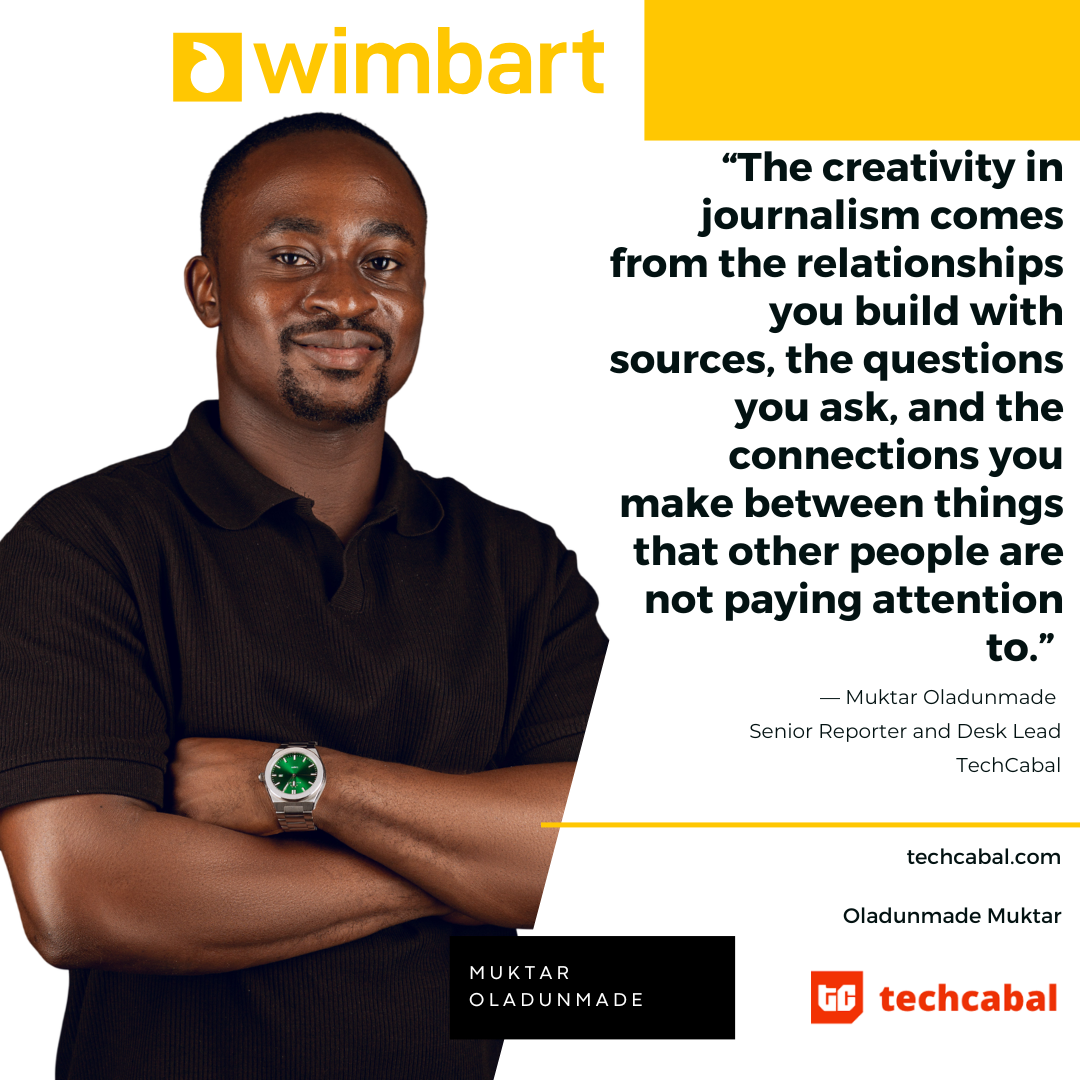
Our journalist spotlight for this month is Muktar Oladunmade, a Senior Reporter and Desk Lead at TechCabal. He discusses his transition from law student to a leading voice in African tech journalism, and the challenges of reporting within the ecosystem.
Muktar also reflects on his proudest work, a human-interest story regarding electricity struggles in his home community, and his evolution into a multimedia journalist through the “Headlines by TechCabal” show.
Read more on the importance of building deep niche expertise and maintaining strong relationships with sources as a journalist.
What led you into journalism, and what would you be doing if you weren’t a journalist?
My love for writing led me to journalism. I think I have told this story several times. I was studying law in the University of Lagos, but by my third year, I knew I did not want to practice law. While I did not immediately know what I wanted to do as a career, I knew that I liked writing (which I actually fell in love with after a friend told me I was talented). Back then, I wanted to work in finance because I did not know that many rich writers and I thought that after a ten-year career in finance, I could retire to be a journalist.
Over time, I started to write, doing the typical student thing by opening a Medium account and publishing 1 (one) story before abandoning it. While the story did well by my humble standards, I never got the confidence to keep turning out more stories. Eventually, I graduated and for a brief period before I was supposed to go to law school, I opened a Substack that published stories weekly about cyrptocurrency and blockchain out of a need to have a writing portfolio (also those were the most talked about technologies in 2022).
That Substack quickly grew to a few hundred subscribers (thanks to my ever-supporting friends and family) and it landed me my job at TechCabal, Africa’s biggest tech publication five months after I graduated from university.
If I wasn’t a journalist, I would have caved into everyone’s advice and would have ended up as a lawyer or I might have been lucky to get that job in finance.
What story are you most proud of, and why?
That would be my January 2025 story on how the community I grew up in (Akiode) was struggling with the effects of near-permanent electricity. One would think that a community that previously struggled with no electricity would welcome having near-constant electricity but if you spoke to anyone in Akiode in 2024, they would tell you that having this much electricity was negatively affecting them.
If you are surprised by this, then I need to paint how Akiode is like to you. It is a community packed with mostly low-income people, with only few middle-class families. This reality means that with near-constant electricity, most residents suffered under the financial obligations of always having power.
The story covers the history of Akiode’s power struggles (my family moved out in 2020 because we once did not have power for two months), the reason why and how the government introduced near-constant electricity, the experiences of the people ( I love human-angle tech stories), and what the future holds for Akiode.
Honestly, I could talk about the story forever and all the things I learned but it’s best of you read it yourself.
Which sectors or industries do you like to cover most, and why?
I honestly try not to see myself as a beat reporter because our ecosystem is so small, but my career says otherwise, seeing as I have almost only covered fintech and venture capital with a few exceptions.
If I had to choose, I will say artificial intelligence (even though I need to improve coverage there), fintech (becasue it is such a consequential sector), and venture capital (finance can be cool). I would also like to do more EV stories.
What’s the hardest part of covering the beat you focus on?
As a tech journalist in Africa, you spend your time covering private companies and venture capital firms, who have no desire or are required to share their numbers with you. This obviously makes the work harder because you have to either work super hard to get hard data to support your reporting or believe what founders tell you (Dash shows that this does not always end well).
What do most founders/business leaders misunderstand about journalists?
Nobody paid me to investigate your company (except Tomiwa Aladekomo and the exec team at Big Cabal Media), and I am not doing this because I have a personal vendetta against you. I am doing this because it is my job, and I like being a journalist.
Founders often think that journalists are the villains in their story but that’s not accurate. We are record keepers that do not influence your internal company procedures.
We just want to tell stories and if you help a journalist understand your business better or explain the difficult part that your business is in, you will see your truth reflected in the final story and more often than not, it softens the blow of whatever it is that I am covering.
Why is it important that people around the world get to hear about young, growing companies on the continent?
I will answer here with a personal real life story.
I am here in Rwanda and an investor recognised my face thanks to our weekly show, Headlines by TechCabal, and he goes on to say that he’s an avid reader of TechCabal and that he follows the ecosystem through the work my colleagues and I do.
As an angel investor with limited resources, he gets all his information about startups through reading TechCabal and he has actually invested in some startups because of what he saw
In another example, one of the founders of Tap’n’GO, once told me that an investor meeting in San Francisco, the investor, in his bid to verify some of the things that he was saying, googled his startup, and an article on TechCabal helped out.
With AI on the rise, is journalism getting more creative?
I think AI is making journalism more efficient, and efficiency can free you up to be more creative. I use AI tools for transcription and for background research when I am trying to understand a new sector or policy. I also vibecoded a tool for some of the production workflows behind Headlines by TechCabal. These are things that used to eat hours of my time and now take significantly less.
But I want to be honest, AI is not writing my stories. The creativity in journalism comes from the relationships you build with sources, the questions you ask, and the connections you make between things that other people are not paying attention to. AI cannot call a founder and hear the hesitation in their voice when you ask about their runway. It cannot sit in a room in Kigali and notice which investors are talking to which startups. The creative part of this job is still very human, and I think AI just gives us more time to do that part well.
What advice would you give to young journalists starting today?
Three things. First, read everything. Read the publications you want to write for, read the ones you think are better than you, read annual reports and regulatory documents and even the boring stuff. The best story ideas come from reading something that everyone else skipped over.
Second, build a niche early. Our ecosystem is small, but it is growing, and the journalists who will thrive are the ones who know their beat deeply. You do not have to limit yourself forever, but having a corner of the industry where people trust your understanding is how you build a reputation.
And third, invest in your relationships with sources. Journalism is a relationship business. The people who pick up your calls, who send you documents, who trust you enough to tell you what is really happening — those relationships are your most valuable asset. Be fair to your sources, protect them when you need to, and never burn a bridge for a headline.
What gives you hope about the future of journalism in Africa?
New business models.
For the longest time, the assumption was that journalism in Africa could not sustain itself, that you either needed donor funding or you had to work for a legacy media house that was slowly dying. But that is changing.
You look at what TechCabal has built and what other publications across the continent are doing, and you see that people like the Continent are figuring out how to make quality journalism commercially viable in Africa.
That matters because sustainability is what allows you to do the work properly. When a newsroom is not worried about whether it will exist next year, it can invest in the kind of reporting that takes time (investigations, long-form features), the stories that actually move the ecosystem forward. I am hopeful because more people are proving that this model can work.
How has it been transitioning to broadcast from written journalism?
Honestly, I did not expect to enjoy it this much. When we started Headlines by TechCabal, I thought of it as an extension of the written work — just another format to deliver the same stories. But it has become its own thing entirely, and I have grown to genuinely love doing it.
The hardest part is balancing it with my writing workload. I am still a reporter with stories to file and sources to call, and producing a weekly show on top of that requires a different kind of energy and planning. Writing is something I can do at midnight if I need to, but a show has a production schedule that does not care whether I am in the middle of chasing a story.