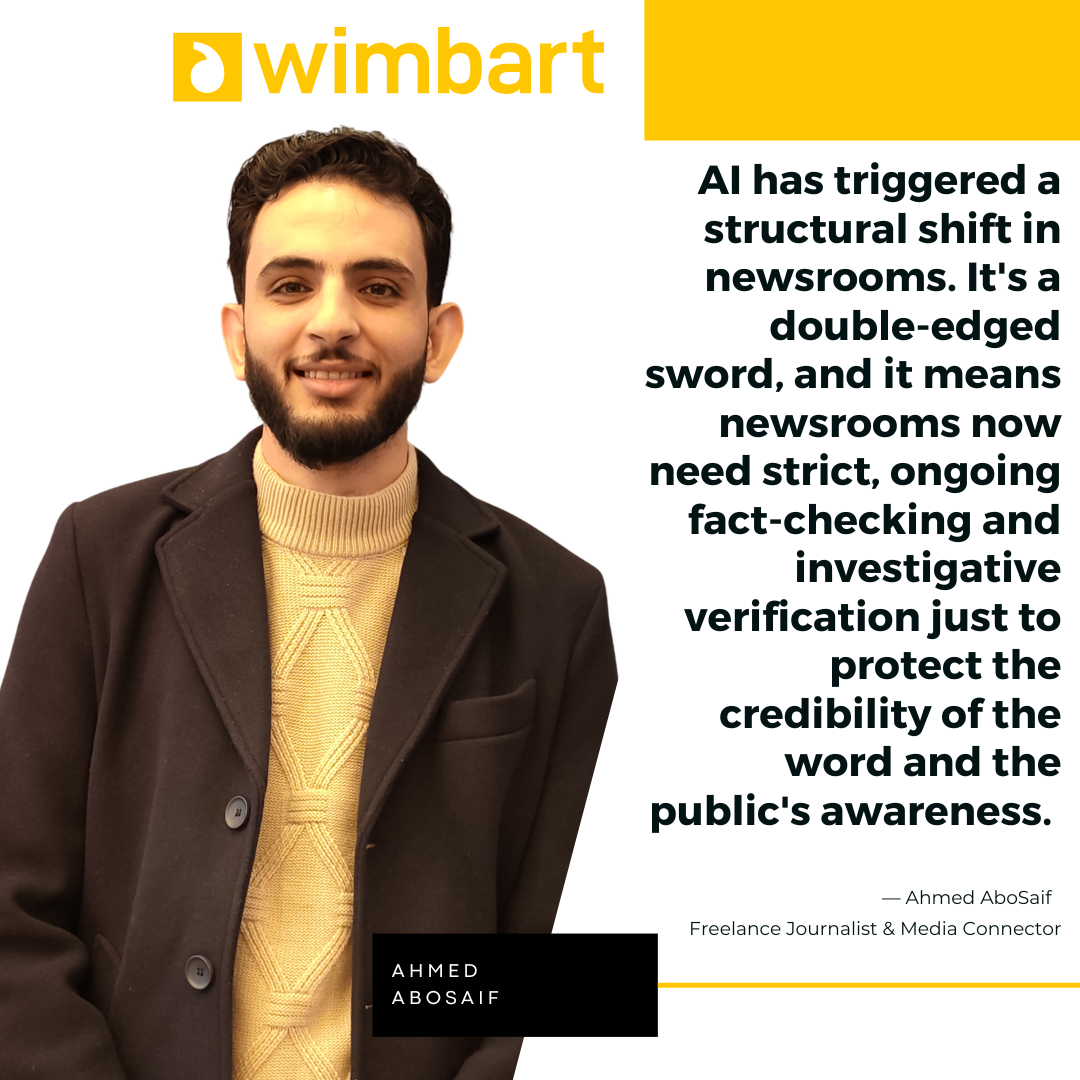
Ahmed Abo Saif, EU Medbridge
Big economic shifts are reshaping the Middle East and North Africa (MENA), and quality business journalism has never mattered more.
In this edition of our Journalist Spotlight, we catch up with journalist and media connector Ahmed Abo Saif. From covering macroeconomics and capital markets across Egypt, the UAE and Saudi Arabia, to navigating the realities of reporting in the region, Ahmed shares what it takes to tell impactful stories.
We also dive into the challenges of data access, AI’s growing role in journalism, common misconceptions founders have about the media, and why protecting journalists from burnout should be a bigger priority.
What led you into journalism, and what would you be doing if you weren’t a journalist?
I’ve followed political and economic events closely since I was a child. I grew up watching the news cover the shifts reshaping the Arab world — the changes in regional politics, the Arab Spring, and above all the Palestinian cause, which was the single biggest thing that pulled me toward the screen. That pull eventually led me to study politics and economics academically, and from there into journalism itself.
I started out specialising in business and economic news through an intensive Internship at Forbes Middle East, where I learned the fundamentals: sourcing information properly and handling it professionally. From there I moved into local field reporting in Egypt with Almal Newspaper, covering the Egyptian Exchange and corporate news, before joining EnterpriseAM as a reporter to cover macroeconomics and capital markets across Egypt, the UAE, and Saudi Arabia at a regional level.
More recently, I joined the EU-funded MedBridge Media Connect network, working alongside colleagues across 12 countries to support journalists and students in their careers.
I’m always learning, professionally and academically — from the Economic Journalism summer school in the American University in Cairo and data journalism diploma with ARIJ to IMF training in macroeconomic forecasting, and right now a Microsoft data analytics certification and CFA studies.
If I weren’t a journalist, I’d probably be an economic researcher or a writer of some kind. For me, it always comes back to writing — whether journalistic, literary, or academic.
What story are you most proud of, and why?
It’s hard to single out one story, because journalism is a daily practice — you’re writing something new every day.
If I’m proud of anything, it’s the cumulative effort: every economic story I’ve worked on has been part of an ongoing attempt to take complicated numbers and turn them into something a reader can actually use, rather than just another headline.
Which sectors or industries do you like to cover most, and why?
I enjoy economic coverage broadly, but I’m most drawn to capital markets, corporate news, and macroeconomics. Partly because they’re the most active beats — there’s always a merger, an acquisition, or a policy shift happening — and partly because the developments there land directly on people’s daily lives, from currency value to the cost of living. That’s what makes them feel close to the reader.
What’s the hardest part of covering the beat you focus on?
The lack of data, consistently. Getting accurate information, or even getting officials at listed companies to talk, is genuinely difficult — partly because exchanges themselves restrict access in the name of “fair disclosure,” which is meant to protect investors but in practice limits what reaches journalists. You see the same gap in banking data, and in government data. When that scarcity meets a broader squeeze on press freedom, the result is journalism working with half the picture.
What do most founders/business leaders misunderstand about journalists?
There’s a real misconception that a journalist exists to polish a company’s image — that we’re essentially a PR function, not someone looking for the truth and what actually matters to readers and markets.
With AI on the rise, is journalism getting more creative?
AI has triggered a structural shift in newsrooms. On one hand, it’s given journalists tools that speed up coverage, sharpen real-time processing, and make data easier to access and analyse — it’s opened up a more flexible space to build skills.
On the other hand, it’s brought a darker side: formulaic writing, a fading human touch in narrative storytelling, and a newsroom environment that now feels like a minefield.
Journalists are under growing pressure from fake content — misleading data, fabricated context, deepfakes.
It’s a double-edged sword, and it means newsrooms now need strict, ongoing fact-checking and investigative verification just to protect the credibility of the word and the public’s awareness.
What advice would you give to young journalists starting today?
Keep learning. The only constant is change — the tools you use today might be different tomorrow, so stay on top of whatever makes the job easier.
Specialise. Don’t spread yourself across every topic; pick one lane and give it everything. The world today rewards depth, not breadth.
Protect your mental health. Journalists across Africa and the Middle East carry a real risk of burnout, given the nature of what we cover and how constantly we’re covering it. Take the breaks you need.
And above all, carry your responsibility honestly — always put in the work to verify what you report.
What gives you hope about the future of journalism in Africa?
Despite everything working against the media landscape across Africa and the Arab world, we can still compete seriously on a global level. It just takes patience and persistence. And at a time when so much journalism is biased, the fact that a freer kind of journalism keeps emerging in our region — one that’s actually trying to get to the truth behind the headline — tells me the future of this profession is still in good shape.