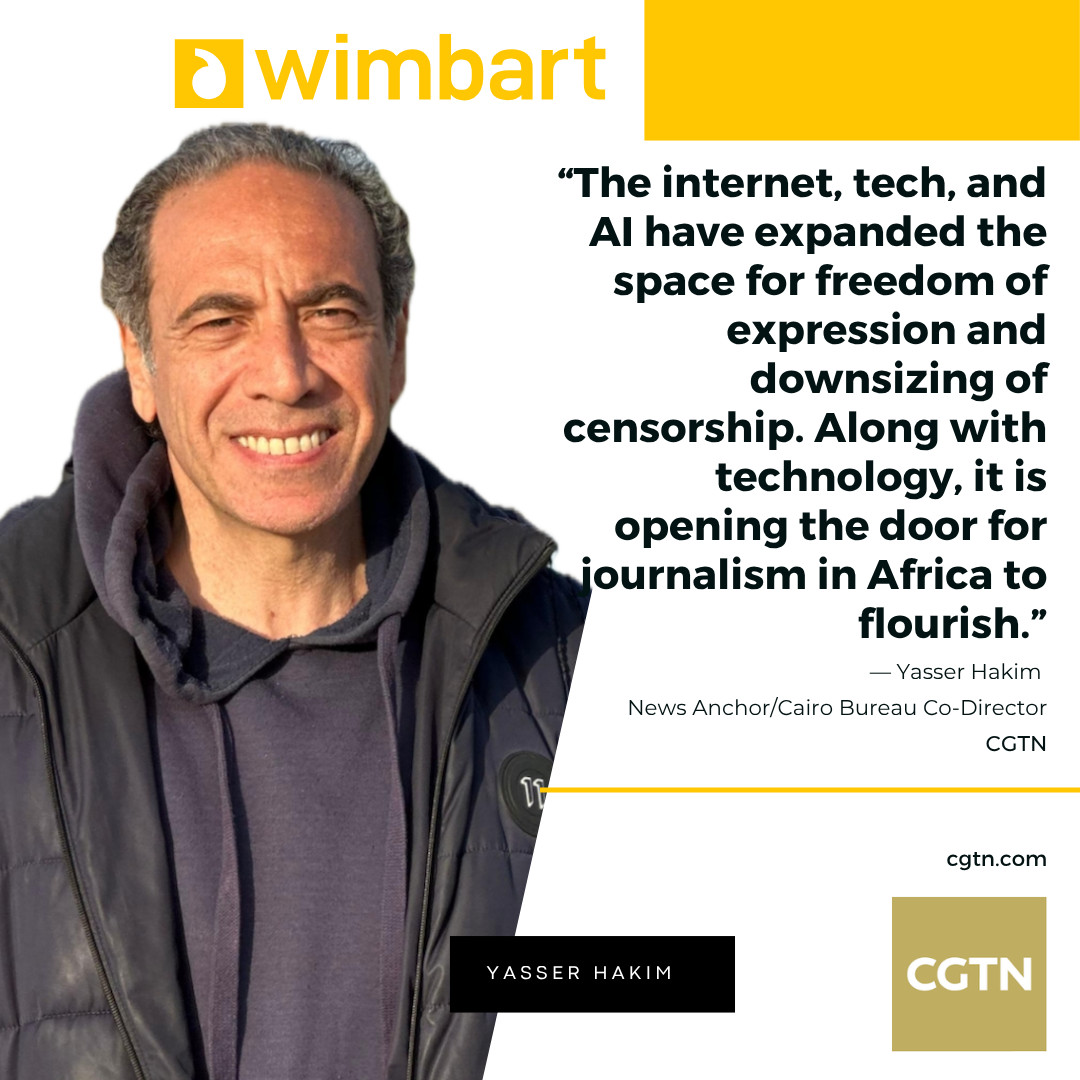
Yasser Hakim, CGTN
For this edition of the African Media Spotlight, we headed to the MENA region to speak with Yasser Hakim, a news anchor and the Cairo bureau co-director at CGTN. With over 25 years of experience telling business and economic stories from one of the world’s most dynamic regions, Yasser has spent his career championing the startups, entrepreneurs, and success stories that the world has been too slow to notice. He spoke to us about the decision that defined his career, what founders get wrong about journalists, why Africa is a continent on the rise, and more. Enjoy!
Why did you go into journalism, and what would you be if not a journalist?
I am a political science graduate with a minor in mass communications. At university, I joined the student journal, wrote articles, and covered events. I was more attracted to the media, although my intended career path was political or the diplomatic corps. For me, covering political and economic news as a media person is like taking the best of both worlds.
A few years down the line, business news became my passion and is now my main beat.
If not in the media, I would have probably become a diplomat. At college, I was active, elected to the Student Union Board twice, and elected as the President of the Political Science Association.
What story are you most proud of and why?
It’s very difficult to pinpoint a certain story in a career that spans over 25 years. I started as an editor, news anchor, reporter, talk show host, and General Manager of Nile TV International, the first English and French-speaking news channel in the MENA region.
I also worked as a business TV journalist on various Arab and American channels, but my longest streak is with CGTN. I have interviewed presidents, top politicians, officials, heads of governments, CEOs, billionaires, small business owners, and entrepreneurs from around the world. I’ve covered numerous summits in Africa, Asia, and the Gulf region, conflicts and wars in the MENA region, and produced an award-winning short docu-series about the Nile river, an African award-winning promo on Business Africa News Show, and local awards on tech tourism stories about Egypt and COP27 and COP28.
I’m not proud of a certain story, but of a decision I took early in my career. Local TV and media were an important part of my journey, and I truly valued that experience and I truly valued that experience for creative and professional growth. I shifted my focus to working with foreign TV channels, specialising in business, where I aim to showcase the success stories in our region for international audiences, whether economic development, successful entrepreneurs, SMEs, or tech companies.
For years, I noticed the continent has not had the exposure it deserved. There are so many talents in our part of the world that, with the right approach, attention, and capacities, would be global leaders in their fields. Social media is now playing a role in introducing these talents, and I’m proud to be one of those pushing for startups and talents to be recognised on international media platforms. One such startup is Halan, which has become the first Egyptian privately owned unicorn.
What I enjoy most is shedding light on the start-up scene in general. Talking to entrepreneurs and startups in North Africa and watching them grow to be successful businesses that also serve the community.
What’s the hardest challenge for the beat you cover?
Lack of information, especially in our part of the world. Credible statistics and transparency are not easy to come by, which makes journalism quite challenging. There is progress where some institutions release stats on a regular basis, but we still need more. Transparency is essential for business news, actually, in all types of journalism.
What do most founders/ misunderstand about journalists?
Journalists are not the PR or advertising tool for a business. Some founders, understandably, are not happy when there is criticism over their project. It’s just that most, at least here, expect journalists to only heap praise and not challenge their stories.
Why is it important for the globe to hear about young companies in the MENA region?
Over the past decade, the MENA region has emerged as a fast-growing hub for businesses and startups, driven by major reforms that have simplified regulations, introduced incentives, and expanded access to funding. The UAE has obviously spearheaded that path, but quickly followed by other countries like Morocco and Egypt. MENA is becoming one of the most attractive regions for foreign investors. Egypt is the top FDI destination in Africa, while the UAE and Saudi Arabia are leading the MENA region for tech and AI startups and financing.
There are numerous success stories.
With AI on the rise, is journalism becoming more creative?
Definitely, AI tools help you be more creative technically; they ease the work itself and speed up the process. However, I’m still a bit old-fashioned in the sense that I do the homework and research myself, not to fully depend on AI or different search tools for information. Any journalist should verify the information, as it’s not always accurate on AI-run search engines.
I just fear that sometimes the ease of sending information or creating news with your mobile phone can lead to the spread of fake news and chaos (intentionally or unintentionally). Watching amateurs or someone who has nothing to do with the media try to play the role of journalists using a mobile phone or AI is sometimes disturbing. It doesn’t always serve the purpose of relaying proper information to the public, but rather seeks trends/clicks regardless of the credibility of the content.
What gives you hope about journalism in Africa?
Africa is a young continent, untapped yet with huge potential. The African youth have better access to technology and are smart enough to compete with the most developed nations. I believe Africa is a continent on the rise, while some other continents are becoming stagnant. The internet, tech, and AI have expanded the space for freedom of expression and downsizing of censorship. Along with technology, it is opening the door for journalism in Africa to flourish.