JACKIE OPARA-FATOYE, SciDev.Net
Kicking off this year’s Media Spotlight series is Jackie Opara-Fatoye, the regional deputy editor of SciDev.Net. She shared why she’s drawn to covering science, health, technology, and development, the power journalism has to make a lasting impact on people’s lives, why she’s excited about the future of journalism, and more. We’re so grateful to Jackie for sharing a bit about her journey with us. Enjoy!
What led you into journalism, and what would you be doing if you weren’t a journalist?
I have wanted to be a journalist for as long as I can remember. Growing up, my father’s daily ritual of reading newspapers and insisting we watch the 9 p.m. news sparked my curiosity about how stories were produced and why they mattered. That curiosity stayed with me as I explored both broadcast and print journalism, before eventually settling into print journalism and then the digital space. Journalism has given me a deep sense of purpose. The ability to bring critical issues to light, improve livelihoods, and share information that can genuinely save lives. If I weren’t a journalist, I would definitely be a lawyer — still advocating for people, still seeking justice, just through a different platform.
What story are you most proud of, and why?
One story I remain deeply proud of is an interview I did many years ago while working with a local newspaper in Abuja, Nigeria. I spoke with a woman living with HIV, and the conversation stayed with me long after the interview ended. I felt an overwhelming responsibility not to let her story simply become another published piece. I went on to connect her with a community of people living with HIV/AIDS, who supported her, counselled her, and helped her access treatment. That experience was a defining moment for me. It was then that I truly understood the real-world impact journalism can have on people’s lives.
Since then, there have been many other impactful stories. Now, as an editor at one of the world’s most trusted science and development media platforms, I have had the privilege of shaping and amplifying stories that influence policy, inform communities, and drive meaningful change at scale.
Which sectors or industries do you like to cover most, and why?
I am most drawn to covering science, health, technology, and development because this is where journalism has the most direct and lasting impact on people’s lives. My early reporting experiences introduced me to science and health journalism, and I quickly saw how these stories could shape public understanding, influence behaviour, and even save lives.
I also became aware that science journalism was rarely prioritised within mainstream media in Africa. They rarely made front pages or prime broadcast slots, despite their relevance. This gap prompted me to think beyond traditional news values and to find ways for my work to reach a wider and more diverse audience. As technology increasingly began to shape healthcare delivery, research, communication, and access to information, it became a natural extension of my reporting interests.
I began seeking platforms that value in-depth coverage of African science, technology, and development stories, where innovation is examined not just for its novelty, but for its real-world impact. I continue to focus on these sectors because they sit at the intersection of knowledge, innovation, policy, and lived experience, and because telling these stories well helps ensure African solutions are visible, credible, and impactful.
What’s the hardest part of covering the beat you focus on?
One of the hardest parts of covering science and development stories in Africa is navigating the gap between complex local realities and public understanding. Many of these issues are deeply context-specific, shaped by social, political, and economic factors that are not always easy to explain or translate. As a science journalist and editor, I carry a constant responsibility to report with accuracy, nuance, and care, ensuring stories are not oversimplified or framed through deficit narratives.
Access remains a major challenge, from limited or fragmented data to underfunded research institutions and scientists who may be unfamiliar or uncomfortable with engaging the media. This often means spending more time building trust, asking deeper questions, and guiding researchers through the storytelling process so their work can be understood beyond academic circles.
On a personal level, being an editor has deepened my sense of accountability. I am constantly aware that the stories we publish shape how science is perceived, how decisions are made, and whose knowledge is valued. The hardest part, but also the most meaningful, is holding that responsibility of making sure African science and development stories are told with integrity, respect, and a clear connection to the lives of people and communities.
What do most founders/business leaders misunderstand about journalists?
Many founders and business leaders misunderstand journalism as publicity, and that is where the tension begins. They often assume that having a compelling product or idea automatically guarantees favourable coverage, without recognising that journalists are not brand advocates.
Another major misconception is the belief that control of the narrative lies with the source. In reality, journalists are tasked with asking hard questions, interrogating claims, and placing stories within a wider social, scientific, or economic context. When founders resist this process or attempt to sanitise their stories, they undermine trust.
The irony is that the founders who benefit most from media engagement are those who understand that journalism is about credibility, not promotion. When leaders approach journalists with transparency, evidence, and respect for editorial independence, the resulting stories are often far more powerful than any press release could ever be.
Why is it important that people around the world get to hear about young, growing companies on the continent?
It’s important to hear about young, growing companies on the continent because these businesses are engines of innovation, solutions, and change. African entrepreneurs are solving deeply local problems, but the lessons, technologies, and models they develop have global relevance.
Too often, the world only hears about Africa in terms of challenges, crises, or deficits. Highlighting these companies helps shift that narrative, showing African talent, creativity, and resilience in action. I remember covering a small tech startup that developed a solar-powered water purification system for rural communities. What struck me was not just the innovation but how quickly it was improving lives, providing clean water to hundreds of households, creating local jobs, and inspiring other entrepreneurs to think differently about technology for social good.
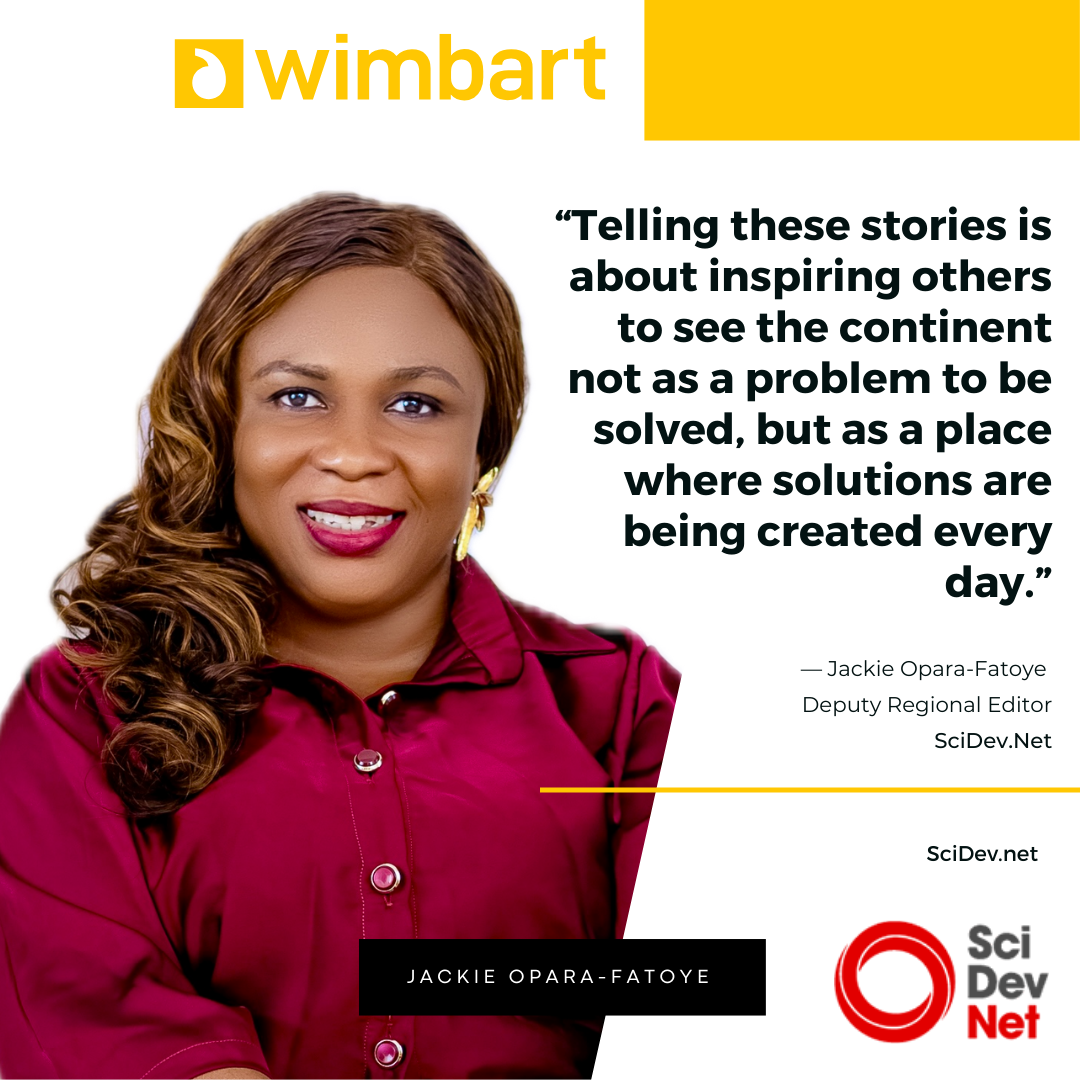
For me, telling these stories is about inspiring others to see the continent not as a problem to be solved, but as a place where solutions are being created every day.
With AI on the rise, is journalism getting more creative?
Absolutely, AI is pushing journalism into new spaces, but creativity has always been at the heart of good reporting. AI can help journalists process data faster, spot trends, or even generate drafts, but it doesn’t replace the human intuition needed to tell stories that matter, that resonate, and that drive impact.
For me, the rise of AI is an invitation to be even more imaginative, to use the tools to explore angles that were previously too complex or time-consuming, to visualise stories differently, or to reach audiences in new ways. But the real creativity still comes from asking the right questions, listening deeply, and connecting people’s experiences to bigger issues. AI can assist, but it can’t replace the judgment, empathy, and curiosity that make journalism transformative.
What advice would you give to young journalists starting today?
My advice to young journalists starting today is to be curious, persistent, and never underestimate the power of their work. Stories can change lives, shift policies, and hold power to account, but that only happens if they go beyond the surface, ask the hard questions, and stick with a story until its impact is clear.
They need to learn to listen more than they speak, and build trust with the people and communities they cover. Understand the context, facts, and always aim for accuracy and depth.
Finally, they should not be afraid to find their own space. When I realised that science and development journalism in Africa wasn’t getting the attention it deserved, I looked for platforms that would amplify these stories. Sometimes, you have to create the opportunities you want rather than wait for them. Journalism is challenging, but it’s also one of the most powerful ways to make a difference.
What gives you hope about the future of journalism in Africa?
What gives me hope about the future of journalism in Africa is the incredible talent, creativity, and resilience I see in the next generation of journalists. Young reporters are no longer just telling stories; they are asking the hard questions, using new tools, and finding innovative ways to reach audiences across digital platforms.
I also see hope in the growing recognition of African stories on the global stage. More people are interested in African solutions, innovations, and voices, and journalists are at the forefront of bringing those stories to light. The challenges remain funding, training, and access to resources, but I am encouraged by the energy, purpose, and commitment of journalists who are determined to make their work matter.
If anything, the future excites me because I know that the continent’s stories are only going to become more visible, more impactful, and more transformative.