
Emmanuel Nwosu, TechCabal
We’re grateful to Emmanuel Nwosu, from TechCabal for agreeing to be the subject of our latest Media Spotlight series. He shared why he’s drawn to Web3 and broader tech reporting, the “hot trend” of resilience in Africa’s Web3 ecosystem, how he thinks AI will affect journalism, and much more.
What led you into journalism, and what would you be doing if you weren’t a journalist?
I studied Petroleum Engineering in college; I’m an engineer by training. But I had a lot of interest in storytelling. I used to do a lot of content and product strategy for a community project, later a Web3 Decentralised Autonomous Organisation (DAO), before joining a crypto off-ramp platform in late 2023. From there, I became gung-ho about Web3.
At the same time, I tried a bit of SaaS journalism and feature writing before I moved to tech reporting. At the start, I did some coverage around startups and funding news, and later spotted an opportunity to build a media voice for Africa’s Web3 reporting at TechCabal. I took my chance because I had some context and previous work in the industry.
I also embraced Web3 and broader tech reporting for another selfish reason. As a journalist, builders give you access to learn how things work at the backend. If I were working at a competing digital assets service company and came to you genuinely asking how you integrated mobile money for stablecoin off-ramps on your platform, you obviously wouldn’t tell me. But you would tell a journalist, and that’s fine. The world works by incentives.
As someone keen about Web3 business and broader business strategy, it made strategic sense to be at the frontlines of reporting innovation and understanding what makes businesses tick. Journalism is easily a career that teaches you a lot of things about a lot of other things. So I traded the hard hat because, weirdly, I was already disillusioned with the fieldwork before I even gave it any real chance.
When you’re researching stories, what compels you to work on sharing a particular story with your audience? Any hot trends we should look out for in the coming months?
I chase stories that make me question assumptions. I cover crypto and Web3 for TechCabal, and I find the space, despite its nascence in recent years, to be highly opinionated. Everyone has a take, but not everyone asks why things are the way they are. I like to think about my engineering and science background as a strength in that regard. Coming from an unorthodox background, I’ve always approached journalism and analysis from a first-principle perspective: What do people assume is true? What is really true? Where’s the nuance, and how can we avoid flattening complex realities about the emerging technology into simple narratives? And, ironically, how can we then turn that complex finding into something so simple for the everyday person to understand?
Web3 is quite a complex abstract technology, and that’s probably why it doesn’t get a lot of interest outside of those already in the “circle.” It’s young, and there’s a lot of figuring out to do. Lots of African builders, mostly new-gen, are doing incredible things with that technology. For me, that’s where the best stories live: in the tension between hype and reality, between what this tech promises and what’s possible in our local reality. Crypto and Web3, especially in Africa, sit right at that crossroads; full of bold, eclectic ideas, but what are the practicalities?
The “hot trend” I’m watching closely is the resilience in Africa’s Web3 ecosystem. Despite the boom-bust cycle, evolving regulatory framework across several jurisdictions—and frankly, the absence of it in some measure—and shifting global sentiment, African founders keep building products with interesting use cases. In the traditional space, fintech is a major sector in several African countries; it’s the same story for Web3. But there are folks bucking that trend. There are interesting things being done around tokenisation, food-tech built on Web3 protocols, art-tech, and tons of infrastructure projects that put us on the map. That’s resilience.
But in the near-term, I see stablecoins playing a key role in finance. People have often joked that stablecoins are solutions to problems that never happened. I like to take a different stance, but I’m also wary about the commoditisation of these digital assets. I also see regulatory clarity evolving across more markets in East and Francophone Africa.
Why is the African business landscape unique, and what makes it exciting to report on?
I’m not sure if it’s unique, but I think Africa’s business landscape, especially in Web3, is unpredictable. First, people are stretching the range of what’s possible to build. The problem with that is it’s hard to distinguish between experimentation and execution. Everyone’s trying something new, but not all of it is sustainable, and that’s okay. It’s part of the process. It’s like watching the sector prototype itself before something in its final form emerges.
What makes it fascinating to cover is how builders adapt to their environments. You’ll find someone using blockchain and digital assets to rethink remittances and payments, and another person using the same technology to build decentralised savings groups, leveraging the transparency that blockchain offers. The Web3 space has gone through some tough times, but interest is returning, and the ecosystem is empowering young people to try really unprecedented things. The experimentation process is chaotic, but in a productive way. Reporting on that unpredictability is what makes this work exciting.
Which sectors or industries do you like to cover most, and why?
Crypto and Web3 (is it obvious?). As I like to describe it, I have a carried passion for a sector that tends to go underreported in mainstream media, even for some of the good it does. My hope is to bring more visibility and representation to this space because it matters deeply to Africa’s tech ecosystem.
Of course, there’s a lot more excitement happening abroad than here. But I think 2025 will probably be the hindsight year, the point we look back on as what catalysed the growth we’ll eventually see across African Web3.
Occasionally, I dabble in fintech, emerging startups, and AI, though my interest in the latter leans more toward the user side – how people interact with these systems and how they change our relationship with technology, rather than the technical side of building them.
I also have the incredible opportunity of overseeing our newsletter products at TechCabal, which keeps me close to the pulse of the ecosystem. I’m constantly tossed into the ring, watching who’s building what, where trends are shifting, and how different sectors are evolving in real time.
Why is it important that people around the world get to hear about young, growing companies on the continent?
It is important because it expands the global understanding of what innovation looks like. African startups are building in Web3, often with multiple infrastructure and access constraints that would discourage many elsewhere. Yet they continue to create solutions that reflect both resilience and originality.
There are also growing efforts from global and local communities that I think deserve a shout-out. They make African builders feel seen and supported. These efforts matter because they validate the work happening here and help sustain an environment where I strongly believe innovation can thrive. These builders are creating new frameworks for how technology can solve real human problems. That story deserves global attention.
How can we encourage more people to tell stories about African tech and business?
Speaking with context about the Web3 space, journalists, builders, and founders, and regulators have their parts to play.
Regulatory clarity for different sub-players in the Web3 ecosystem will encourage more founders to come public about the interesting things they’re building, and they’ll no longer need to play hide and seek underground. Many currently operate in stealth or semi-private communities because of uncertainty, but clearer guidance and frameworks would remove that fear.
Regulation is still catching up, true, but with more pro-digital asset regulators at the helm, greater uniformity, role clarity, and continued collaboration between builders and government officials, we can expect a healthier, more open environment. That openness will, in turn, expand the kinds of stories the media can tell.
Founders and builders also need to make themselves more accessible to journalists. When they make access easier and storytelling more collaborative, we can build a more complete and nuanced picture of the ecosystem. Founders should see journalists as partners in building context, not just amplifiers of announcements or funding news.
On the journalism side, we need to equip more young reporters with the skills and confidence to cover complex topics like crypto, blockchain, and Web3, in plain language. It becomes easier to interpret the dynamism in the industry in an accessible language.
What are your thoughts on Artificial Intelligence in journalism?
AI is changing journalism in two ways: how we use it personally and how it’s applied in the business of news.
On a personal level, I use AI to improve how I work. It helps me think through ideas, test objectivity, and check for biases that sometimes slip through human judgment. Here’s a secret: at least two TC Daily subject lines every week come from ChatGPT. I see it as a tool for thought.
On the business side, I see it as an opportunity and a challenge, but mostly an opportunity. Google’s generative search experience, which summarises the news when people search for something, has made finding information easier and more direct. But it also creates room for something valuable.
Expansive reporting can give people the context behind the story – the why beyond the what. And when AI summaries surface those kinds of stories, they become windows that draw readers in. People click through when there’s depth, and that is where journalism keeps its power.
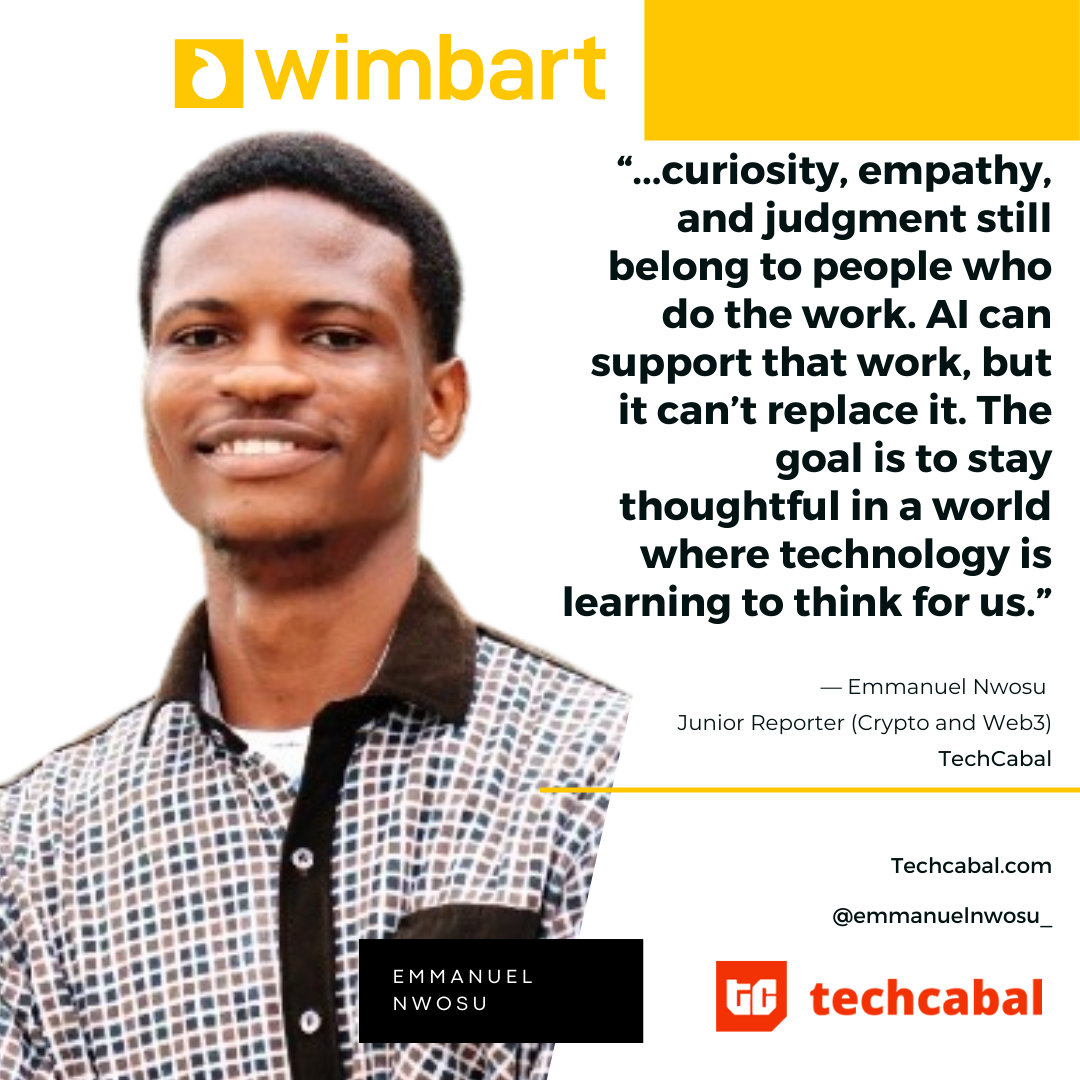
At the end of the day, curiosity, empathy, and judgment still belong to people who do the work. AI can support that work, but it can’t replace it. The goal is to stay thoughtful in a world where technology is learning to think for us.