
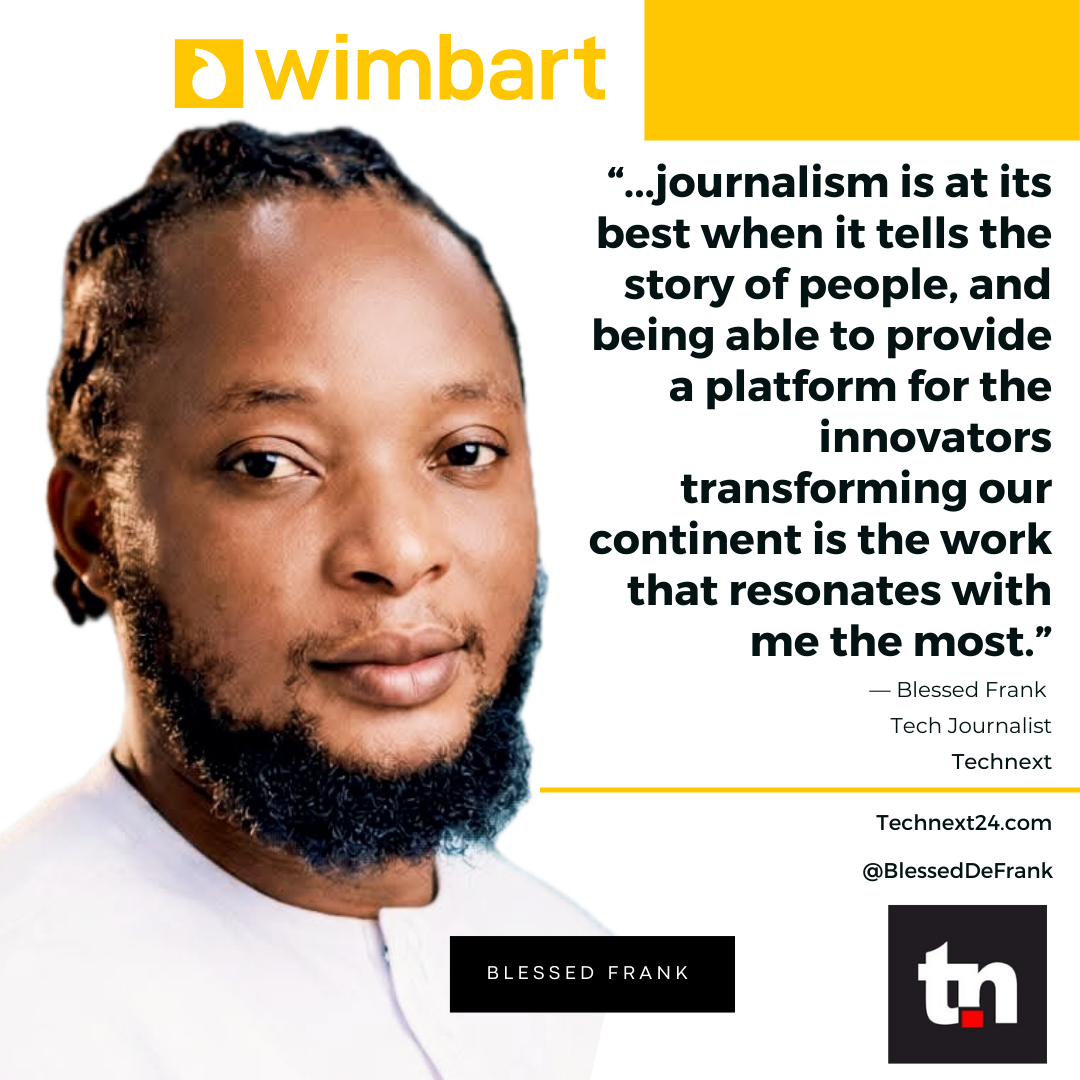
Blessed Frank, Technext
This next edition of the Media Spotlight series is with Blessed Frank, a tech journalist at Technext. Blessed shared his journey from student journalism, independent publishing, deep dives into Blockchain and AI, plus why storytelling matters and why the continent’s innovations deserve a global audience. Enjoy!
What led you into journalism, and what would you be doing if you weren’t a journalist?
I believe I was born with the curiosity of a journalist, though for a long time, I thought I was destined for the courtroom. If I weren’t a journalist today, I would certainly be a lawyer.
As a child, I was so inquisitive that my family and neighbors actually started calling me ‘Lawyer’ before I even finished primary school. I took that identity to heart, but when I wasn’t admitted to study law in 2013, I pivoted. In 2014, I began my studies in English and Communication Studies, and that’s where my childhood habit of devouring national dailies and listening to the radio every morning finally found its professional home.
My path into the industry was a steady build from that point on. I started as a student journalist at my university’s paper, FOUTIMES, which gave me my first real taste of reporting. However, it was my industrial training at the Nigerian Television Authority (NTA) that really showed me the inner workings of the media industry. After graduation and my national service, my friends and I weren’t ready to wait for permission to write, so we co-founded a Substack platform to practice independent journalism on our own terms.
That spirit of exploration eventually led me to the tech sector. In January 2022, I officially transitioned into tech journalism by joining TheOuut, and later Technext in 2025. Looking back, while the ‘child lawyer’ in me still values evidence and advocacy, I’ve found that journalism allows me to use that same inquisitiveness to tell stories that actually shape how people understand the world, especially in the fast-paced world of technology.
What story are you most proud of, and why?
Over the course of my career, I have authored more than a thousand articles covering everything from breaking news to interviews and deep-dive market analysis. However, if I had to choose the work I am most proud of, it would undoubtedly be my Founder’s Spotlight series at Technext.
These stories are my favorites because they go beyond the numbers and the code to focus on the human element of the industry. Through this series, I’ve had the privilege of documenting the journeys of real people who are actively shaping the technological landscape across Africa and beyond.
There is something incredibly fulfilling about capturing the grit, the vision, and the personal sacrifices behind the innovations we see today. For me, journalism is at its best when it tells the story of people, and being able to provide a platform for the innovators transforming our continent is the work that resonates with me the most.
Which sectors or industries do you like to cover most, and why?
My focus is primarily on the emerging technologies sector, specifically Blockchain and Artificial Intelligence. I am drawn to these industries because they represent the current frontier of human innovation, where the rules are being rewritten in real-time.
I find these sectors the most rewarding to cover because they demand the same level of inquisitiveness that first drew me to journalism. In traditional industries, the narratives are often well-established, but in emerging tech, every story is a puzzle. Whether it’s the shift toward decentralization in Web3 or the ethical implications of AI, there is a constant need to demystify complex concepts and explain how these breakthroughs will practically impact society.
What’s the hardest part of covering the beat you focus on?
The most significant challenge in covering niche beats like blockchain and AI is overcoming what I call the ‘curse of knowledge,’ because the industries are still very nascent, I spend my days deep-diving into decentralized protocols and agentic AI frameworks, the primary hurdle is constantly translating that complexity for an audience that ranges from seasoned developers to curious newcomers.
The hardest part is simplifying these concepts without stripping away their essential nuance. It is a delicate, often exhausting, balancing act: if I make a story too simple, I risk losing technical accuracy and the trust of industry experts; if I make it too dense, I lose the general audience entirely. Finding that ‘sweet spot,’ where a complex technical concept transforms into a clear, accessible, and accurate narrative, is a necessary daily exercise that requires constant vigilance and effort.
What do most founders/business leaders misunderstand about journalists?
Based on my experience, I will say many founders view journalists as a branch of their own PR or marketing departments. The most common misunderstanding is the belief that our primary role is to act as a megaphone for their brand’s ‘success story.’
In reality, a journalist’s first loyalty is to the reader and the truth, not the company’s valuation. Founders often expect us to publish their press releases verbatim or focus only on the ‘all-is-well’ narrative of a funding round.
They sometimes misunderstand that the ‘grit,’ the failures, the pivots, and the regulatory hurdles, is actually what makes a story relatable and credible. When founders understand that a journalist is looking for a balanced, objective narrative rather than a polished advertisement, it builds a much more authentic and impactful relationship.
Why is it important that people around the world get to hear about young, growing companies on the continent?
It is important that people around the world hear about young and growing ventures on the continent because global storytelling is no longer an optional extra, but a strategic necessity for the continent’s economic and social trajectory. When these stories reach a global audience, they actively dismantle old barriers and build new bridges.
Global visibility is a fundamental driver for attracting international investment and reducing the risk premium that often inflates the cost of capital in emerging markets. When the successes of these companies are consistently reported, it builds a track record of credibility that helps investors overcome institutional biases and perceived instability. This increased transparency not only facilitates the flow of venture capital but also opens doors for cross-border partnerships and deeper integration into global supply chains.
Also, highlighting these companies is essential for dismantling the monolithic global narrative that has historically defined the continent through crisis and dependency. By showcasing innovation and resilience, these stories replace outdated stereotypes with a nuanced reality where local founders are seen as creators of global solutions. This shift is crucial because it moves the international conversation from one of charitable aid to one of strategic partnership. Ultimately, these achievements serve as a blueprint for the next generation of entrepreneurs, proving that high-impact innovation is possible from within, which fosters a more competitive and self-sustaining economic future.
With AI on the rise, is journalism getting more creative?
Yes, journalism is becoming significantly more creative as AI matures into a powerful force multiplier for human ingenuity. By liberating journalists from the drudge work of the newsroom. AI restores the mental bandwidth required for high-value storytelling. When reporters are no longer consumed by the mechanics of production, they can reallocate their energy toward investigative depth, character-driven narratives, and the nuanced editorial judgment that defines the heart of the craft.
Beyond simple efficiency, AI enables creative investigative angles that were once physically and financially impossible. Sophisticated data-mining algorithms can now scan millions of documents to uncover hidden patterns, while AI-driven satellite analysis provides real-time monitoring of environmental or geopolitical shifts. These tools serve as an equalizer, allowing even small, independent teams to produce high-impact, global-scale stories that were previously the exclusive domain of legacy newsrooms with massive budgets.
Finally, AI is revolutionizing how information is architected and delivered to a fragmented audience. It allows for the technical translation of complex topics, enabling a single journalist to transform a dense investigative piece into interactive data visualizations, personalized summaries, or multimodal experiences across various platforms. By bridging the gap between technical complexity and public understanding, AI pushes the journalist to evolve from a recorder of facts into an innovative architect of information, ensuring that vital stories resonate in an increasingly crowded digital age.
What advice would you give to young journalists starting today?
For young journalists starting out today, the industry is both challenging and rich with opportunity. The craft is evolving fast, but some core principles remain. First, master the fundamentals of reporting and writing. Clear, accurate writing is still the foundation of great journalism. Editors and audiences alike prize work that is precise, engaging and verifiable.
At the same time, embrace the digital tools shaping newsrooms. Today’s journalists need more than a notebook and pen. Learn how to work with multimedia formats such as video, audio and data visualisations. Understand social media dynamics, SEO and mobile-first reporting. These skills make your work more discoverable and relevant.
Network deliberately. Connect with peers, mentors and editors. Attend events, join professional organisations, engage thoughtfully on platforms like X and LinkedIn, and be curious about others’ processes and perspectives. Strong professional relationships open doors and enrich your understanding of the craft.
As you grow as a journalist, stay curious and informed about global and local developments. Read widely, follow trends, and ask probing questions in your reporting. Curiosity drives deeper insights and better journalism.
Finally, recognise that journalism is a public service. The aim is not just to report events but to help readers understand them. Treat ethical standards, context and clarity as obligations to your audience. Stay resilient, stay inquisitive, and keep experimenting with new ways to tell the truth.
What gives you hope about the future of journalism in Africa?
I’m particularly excited that African journalists are increasingly becoming the primary authors of the continent’s narratives. The region is no longer framed mainly through crises and challenges by the Western media. A new generation is using digital platforms and independent media to tell more accurate, ambitious and innovation-led stories, often without waiting for institutional permission.
I am also encouraged by the rise of niche expertise across African journalism. There is a clear shift away from broad generalism towards reporters who can translate complex sectors such as technology, finance and policy for local audiences. This kind of specialisation builds trust, while ensuring Africans are informed participants in shaping global trends, not passive observers.
Finally, the growing spirit of independence is deeply motivating. Journalists are building Substacks, community-driven newsrooms, and direct relationships with younger, tech-savvy audiences who value transparency. By bypassing traditional gatekeepers, we are moving from simply reporting problems to documenting solutions, resilience, and progress. That shift is why the future of journalism in Africa feels genuinely hopeful.